The following is a CfP for a Spring 2020conference I co-wrote alongside members of my cohort, Leticia Berrizbeitia Anez, Kareem Elhais, and Kaifan Wang.
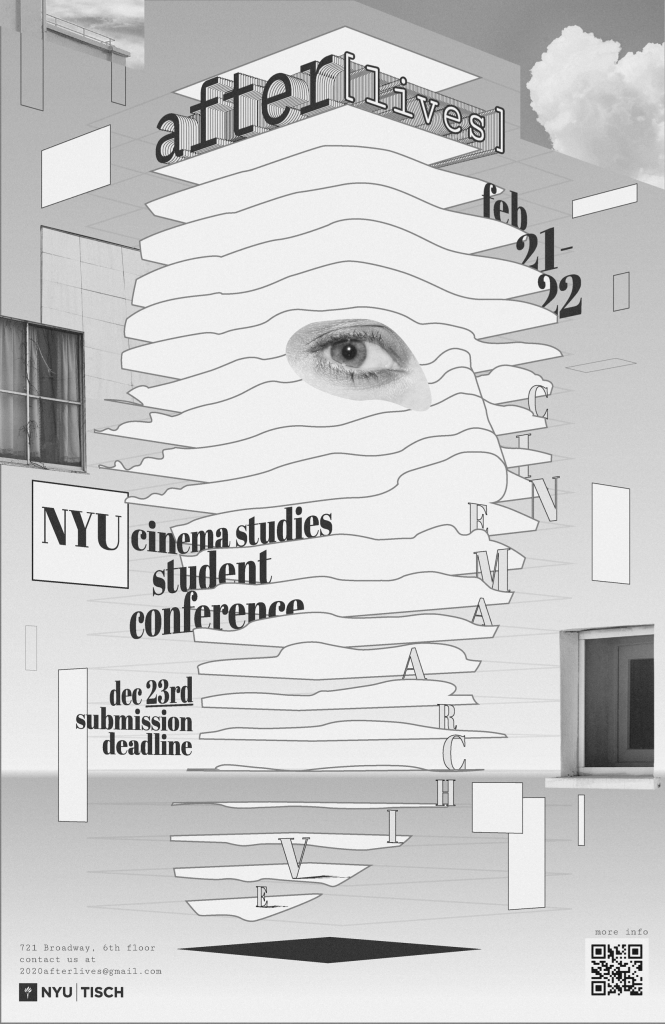
a f t e r [ l i v e s ]
NYU CINEMA STUDIES STUDENT CONFERENCE
Feb. 21-22, 2020
2020afterlives@gmail.com
Keynote Speaker: Mona Kareem, (Assistant Professor of Arabic Literature, University of Maryland)
Keynote Title The Ghosts who bring down Capitalism from Albert Cossery to Mati Diop
There is an inherent violence in the passing of time. Michele Wallace once wrote: “[e]ither we will make history or remain the victims of it.” There can be little to no doubt that in the current times, the struggle of those on the margins has never been more visible while, at the same time, silenced. From the raging streets of Hong Kong, Chile, Bolivia, Lebanon, Iraq, Algeria, Sudan, and Venezuela (to list a few) to the blazing rainforests and political bodies, we ask: how can these visible (yet muted) tensions and imaginations incite futures to come? Will 2019 be remembered in history as another 1968? Or would history deny these marginalized movements an afterlife?
Andre Bazin once compared film to the process of mummification because both were methods for preserving the dead. Bazin’s assertion does not seem to be true for all films: think of forgotten films, destroyed archives, decaying images, subjugated knowledges, and controlled cultural industries. Some films and other historical documents (including Bazin’s work) acquire canonical significance—a mummified afterlife of celebration—while others end up with a buried status and ghostly presence. It is true that moving images allow us to see the past in the present, yet it is how we see it and talk about it that constitutes ethical, ideological, and political pivots.
What does it mean for something to be dead yet lingering and exerting power and influence? a f t e r [ l i v e s ] can be understood as the present investigation of the past and future. It calls us to interrogate these avenues of death, decay, immemory, and history through moving-images, interdisciplinary scholarships, and beyond. Other than being a stylistic choice, our use of brackets in “a f t e r [ l i v e s ]” delineates a variable, an invitation to investigate the futurity and undeadness of different past archives and ideas, a space through which history can be exposed, re-written, and re-experienced.
Potential topics can address, but are not limited to, the following:
- (UN)DEAD CINEMA, MEDIA, AND THE DIGITAL WORLD
- ARCHIVE, AFFECT, AND THE EPHEMERAL
- a f t e r [THEORY / CRITIQUE / CANONS]
- DIASPORA, TRAUMA, AND MEMORY
- UTOPIA, APOCALYPSE, AND FUTURISM
- COLD WAR PASTS / (NEO)LIBERAL PROJECTIONS
- POST[COLONIALITY] AND IDENTITY POLITICS
- a f t e r [GENDER / BIO / NECRO] POLITICS
- BIOSPHERE AND CATACLYSM
- [QUEER / FEMINIST] ACTIVISM AND LIMINAL SPACES
Please submit an abstract (250-300 words) and a short bio (max. 100 words) to 2020afterlives@gmail.com no
later than Dec. 23, 2019. If you’re submitting a film, art, or performance work, please include documentation—
stills, videos, etc. in addition to the abstract. Links are preferable to files.
Participants will be notified by the second week of January, 2020. We look forward to reading your proposals.
 SPL9
SPL9 